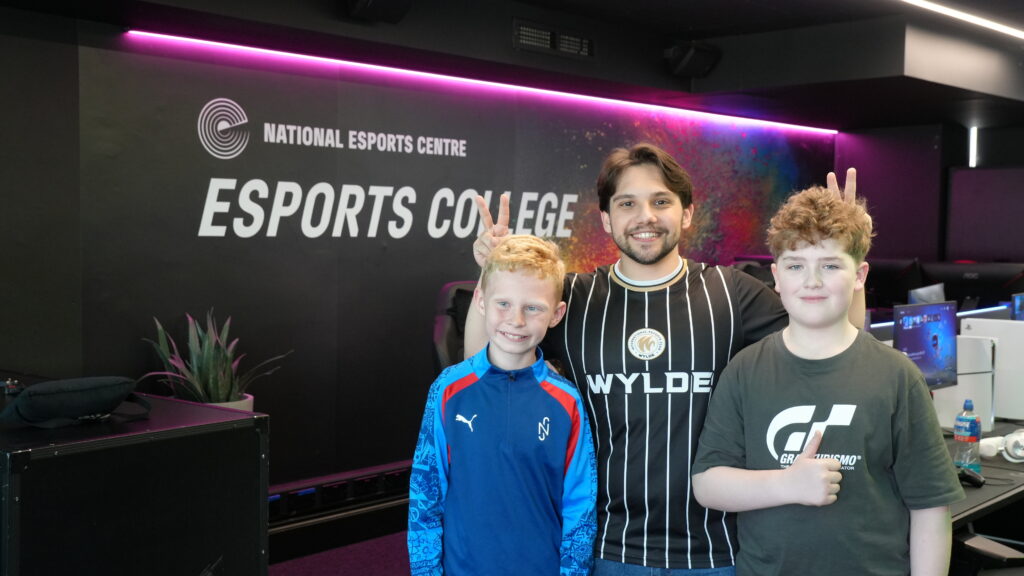
Since the 7th of July we have been running gaming camps at the National Esports Centre in Cork. Across five weeks, more than 80 children came through our doors to work on their game skills, their communication, their teamwork and leadership. Every day of it was delivered by WYLDE staff at the NEC.
I want to write down what I saw, because I did not expect it.
Day one: the ten minutes at the door
The reaction on arrival is always the same. A child walks into the NEC and stops. The setups, the PCs, the racing rigs, the lights. You can watch them recalculating what the week is going to be.
Then they leave their parent at the door and step into the middle of the room, where we ask them to say something about themselves: what they play, what they are into. I always expected that to be the hardest moment of the week, and for some of them it is. The first few to speak have it worst, because they have no idea yet what the rest of the group is going to make of them. But once three or four kids have named their game, you can watch the room settle. Whatever they were bracing for is not going to happen here.
And then, every week, the same discovery. Six other kids in the room play the same games, are the same age, want the same things. Children who arrived braced to be the odd one out realise, in about four minutes, that they are not.
Day two: the day it stops being polite
Day two is communication day, and it is the day the camp actually turns. We play games like Overcooked and Pico Park, games nobody can win alone. A level will not clear unless four people say the right thing at the right time, and for the first while, nobody does.
You can watch the frustration build. The level fails, and fails again, and the nerves come up because nothing is working and everyone knows why. Then somewhere in there a boy of about ten who had barely spoken since drop-off starts talking. Okay, what’s missing. What do we need to do. How do we win this? By the end of the session he is the one pausing the game to explain the plan, and celebrating when it works. Children who were reluctant on Monday to say out loud what they were into are leading a team by Tuesday afternoon, and asking to play against the group at the next station.
None of that is left to chance. I put the groups together myself, after watching the first morning: who is looking for a way in, who needs a louder table, who will get further sitting beside a particular kid than beside their first choice. Then I stay in the room. By day two they are pulling me over to show me something, or asking to play against me, which is usually the sign that the group has settled.
Half of it does not even happen at a PC. Break and lunch are where the real work gets done, swapping notes on how the morning went, finding out who else plays the same thing, arguing everyone into trying a game mode nobody else has touched.
Between the weeks: the kids who came back
More than ten children booked in for more than one week, either the week straight after or a fortnight later, and that is where the change was impossible to miss.
Week one, day one: shy, quiet, watching the room. Their next week, day one: through the door and straight in. Different faces around them, same mentality, and they already know what the week holds and how good it is going to be. Watching the same child walk in for the second time is the closest thing to proof I have.
Day four: the last day
Day four is the camp tournament, and it is deliberately not a serious one. We run through Minecraft Bed Wars, and whatever is still unresolved at the end of it gets settled by a rock paper scissors tournament. They cheer for each other, they celebrate for each other, and they are just as delighted when a mate loses, because that is a whole afternoon of slagging earned fairly.
It is also the day they stop noticing the room. The rigs and the lights that stopped them at the door on Monday are furniture now. What they do not want to leave is each other.
Nobody wants to go. The questions are always the same two: Can we come back during the year? Do you do anything else?
Out at the door, the parents are swapping email addresses so the kids can keep playing together from home. That is not a camp activity. That is a friendship, and it was built in four days in front of us.
They go home talking about what they learned, what they played, who they met. More than once I have had a parent come back in with the other parent in tow, because what their child described sounded too good to be true and they wanted to see the place for themselves.
“Mom, they actually understand me and what I’m saying.”
What one boy said when he got home, as told to us by his mother
She also told me that as soon as they stepped in, she knew this was his place, and that watching him say goodbye to his new friends was the best part of her week.
That is the sentence I keep coming back to. A lot of these children are the ones who do not slot easily into the normal after-school activity, who go through the school year feeling slightly misunderstood. It turns out they were not hard to understand. They were in the wrong room.
What we are doing next
For five weeks, when a child asked do you do anything else?, our honest answer was not good enough. So that is what we are building now. The camps worked. Five weeks, more than 80 children, and a room full of kids asking for more. The natural next step is somewhere they can come every week rather than once a summer.
We are opening our first Gaming Club at the National Esports Centre in Cork, for ages 8 to 15, running weekly during term. If your child was at camp this summer and has been asking when they can go back, this is the answer. And if they were not, this is a good place to start.